Part-time
Live online lessons
German B1+
Training programme

KI-Spezialist:in für Prompting, Prozessoptimierung & Business-Automatisierung

(AI automation specialist)

Learn to improve business processes and automate tasks with AI. Build your own AI assistants and practical solutions for businesses.

Format
Part-time · Mon, Wed, Thu
Duration
5 months
Teaching units
420 UE (teaching units)
Portfolio
9 projects

Course overview

Qualification
Spezialist:in für KI-gestützte Geschäftsautomatisierung

Format

Part-time, live online classes
3 teaching days per week

Schedule

Mon, Wed, Thu, 17:00–20:15
Live trainer-led classes, followed by independent study and project work

Duration

5 months
420 UE (teaching units)

Language of instruction

German
B1 or above

Practice

8 module projects and a final project
Build a portfolio for job applications

Aims and learning outcomes

Aim of the course

You’ll learn to analyse and improve business processes and identify tasks that AI could automate. This will help you prepare for working in the business automation field.

The course is designed around labour market needs. According to StepStone, more than 14,000 job adverts require skills in AI, business processes and automation.

What you’ll be able to do

By the end of the programme, you’ll be able to:

Analyse business processes (AS-IS / TO-BE) and identify tasks suitable for AI

Automate tasks with n8n and connect services through APIs and webhooks, without having to write code

Build AI assistants, AI agents and RAG systems with human oversight (HITL)

Improve data quality and protection, while considering the GDPR and EU AI Act

Calculate the costs and benefits of an AI project, including ROI, TCO, token costs and an AI roadmap

Automate a business process from start to finish and present your solution

Entry requirements

You should meet the following requirements:

Digital skills

Confident using a PC, Excel, CRM and ERP systems

Experience with AI

Basic practical experience

German language

At least B1 level

Programming skills

Not required

We’ll review your application before confirming your place.

Language of instruction

B1 – Classes are taught in German. B1 level is enough to get started.

CLIL approach (Content and Language Integrated Learning):

You’ll learn the subject while practising German for the workplace.

In the introductory module, you’ll practise communication and teamwork in a German-speaking workplace.

Course structure

You’ll complete the modules in order, from the introduction to the final project.

Introduction

AI audit of business processes

Prompting and n8n

Data architecture

Data quality

RAG and HITL

GDPR and EU AI Act

Project costs and AI roadmap

AI agents

Final project

Modules

The course has 10 modules: an introduction, eight subject modules with one project each and a final project.

Module 0.

Introduction and workplace skills for a German-speaking environment

Get to know the learning platform and essential digital tools. You’ll also learn to plan your study time and work with a team online.

Topics:
Using the learning platform and digital tools
Study strategies and time management
Communication and teamwork
Managing conflict and cultural differences
Self-organisation and motivation
Professional networking
Outcome:

Your personal learning and development plan

Skills:

Plan your study time, work independently, communicate and collaborate in a German-speaking team

Tools:
Learning management system (LMS)Collaboration tools
Module 1.

AI audit of business processes: AS-IS mapping and TO-BE design

Review an existing business process and find areas that need improvement. Design a better workflow and decide where AI could help.

Topics:
Describing and mapping the current (AS-IS) process
Interviewing people involved in the process and gathering requirements
Finding problems and their root causes
Assessing and prioritising AI opportunities
Designing the future (TO-BE) process and defining the first pilot project
Outcome:

Project 1, "AI audit: from AS-IS to TO-BE"

Skills:

Map processes, gather requirements, identify problems and assess AI solutions

Tools:
AS-IS / TO-BERoot cause analysisOpportunity mapInterviews
Module 2.

Prompting and automation: a custom AI assistant and n8n workflows

Build your own AI assistant and automate a workflow with n8n. Learn how different digital services can work together.

Topics:
Advanced prompting and system instructions
Designing a custom AI assistant
Classifying and processing incoming data
APIs, webhooks and OAuth
Building and testing automations in n8n
Outcome:

Project 2, "AI Email Assistant"

Skills:

Write prompts, build AI assistants, classify data and connect services

Tools:
n8nLLM platformsAPIsWebhooksOAuthJSONGmailGoogle Calendar
Module 3.

Data architecture for AI projects

Learn how to prepare and store data for AI systems, including documents and other unstructured data.

Topics:
ETL and ELT processes for unstructured data
Relational and vector databases
Preparing documents for RAG
Chunking and embeddings
Building and testing data pipelines
Outcome:

Project 3, "HR Data Pipeline"

Skills:

Prepare unstructured data, choose a suitable data structure and build data pipelines

Tools:
ETL / ELTChunkingEmbeddingsRelational databasesVector databases
Module 4.

Data management and data quality

Learn how businesses organise their data and check its quality. Explore rules for safe data use in AI systems.

Topics:
Data governance and responsibilities
RACI and data owner roles
Measuring and validating data quality
Cleaning and preparing datasets
Data protection and safe-use rules
Outcome:

Project 4, "Data Governance and Quality Framework"

Skills:

Assign data responsibilities, measure quality and improve datasets

Tools:
Data governanceRACIData ownershipData quality rules
Module 5.

Advanced RAG systems and human-in-the-loop

Build an AI agent that uses information from a knowledge base. It can process new documents and involve people in important decisions.

Topics:
Chunking and hybrid search
Automated document processing in n8n
Designing a RAG pipeline
Human-in-the-loop and rules for passing complex cases to people
Updating the knowledge base and checking answer quality
Outcome:

Project 5, "RAG agent with HITL"

Skills:

Build RAG pipelines, set up document search, add human oversight and check answer quality

Tools:
n8nVector databasesRAGHybrid searchHuman-in-the-loop
Module 6.

Legal compliance: GDPR and the EU AI Act

Learn the main legal requirements for AI systems. Assess possible risks and prepare documents on data protection and compliance.

Topics:
Anonymising personal data (PII)
Classifying AI systems by risk level
Requirements of the GDPR and EU AI Act
Data protection impact assessments (DPIAs)
Assessing providers and auditing compliance
Outcome:

Project 6, "DPIA and Compliance Package"

Skills:

Anonymise personal data, assess AI risks, document data protection and evaluate service providers

Tools:
GDPREU AI ActDPIAPII anonymisation
Module 7.

Costs, risks and the AI roadmap

Learn to calculate the costs and business value of an AI project. You’ll also plan how a business can introduce AI step by step.

Topics:
ROI, TCO and payback period
Calculating and reducing token costs
FinOps for AI systems
Assessing risks and different scenarios
Creating an AI roadmap and presenting it to leadership
Outcome:

Project 7, "FinOps and AI Roadmap Dashboard"

Skills:

Assess project value, calculate and manage costs, evaluate risks and present findings

Tools:
ROITCOPaybackFinOpsToken costsAI roadmap
Module 8.

AI agents, multi-agent systems and quality checks

Design a system in which several AI agents work together on their own tasks. Decide how to assign work to the right agent and check results.

Topics:
Agent roles, permissions and routing
ReAct and Model Context Protocol (MCP)
Routing tasks to the right agents
Human-in-the-loop and error handling
Evaluation pipelines and quality control
Outcome:

Project 8, "Multi-Agent System"

Skills:

Design multi-agent systems, assign tasks, handle errors and check quality

Tools:
ReActMCPRouterHuman-in-the-loopEvaluation pipelines
Module 9.

Final project

Bring together what you’ve learned during the course. Build and present an AI solution for a business process.

Topics:
Choosing and describing a business process
Designing the target architecture for automation
Connecting data, AI components and human oversight
Monitoring the solution in use
Documenting results and presenting the project
Outcome:

Final project, "End-to-End AI Automation"

Skills:

Plan a complete AI solution, connect data and AI components, monitor the system, document and present results

Tools:
n8nOpenRouterSupabase (pgvector)Telegram BotGmail

Your portfolio

You’ll complete 9 projects in areas such as HR, logistics, sales and marketing. You can present them when applying for jobs.

Final project:

End-to-End AI Automation

Build a prototype multi-agent system for a practical task. Work through each stage, from analysing the problem to calculating ROI and documenting the solution.

Presentation:

10–12 minutes. Present your solution and answer questions.

Example topics:
E-commerceHRKnowledge baseRestaurant
Project 1
AS-IS / TO-BE

AI audit: from AS-IS to TO-BE

Analyse a business process and plan how to use AI

Project 2
n8n

AI Email Assistant

Automate email tasks with n8n

Project 3
ETL · Embeddings

HR Data Pipeline

Prepare CVs and documents for AI search

Project 4
RACI

Data Governance and Quality Framework

Set rules for data quality and safe data use

Project 5
RAG · HITL

RAG agent with HITL

Build an AI agent with a knowledge base and human oversight

Project 6
GDPR · AI Act

DPIA and Compliance Package

Prepare GDPR and EU AI Act documents

Project 7
ROI · TCO

FinOps and AI Roadmap Dashboard

Assess project value and build an AI roadmap

Project 8
Router · MCP

Multi-Agent System

Build a system of AI agents with quality checks

Download the curriculum (PDF)

Career opportunities

The course prepares you for roles in process analysis, automation, AI project management and digital transformation.

AI managerData quality specialistProcess automation specialistAI consultantBusiness process managerAutomation managerAI project managerDigital transformation manager

Certificate

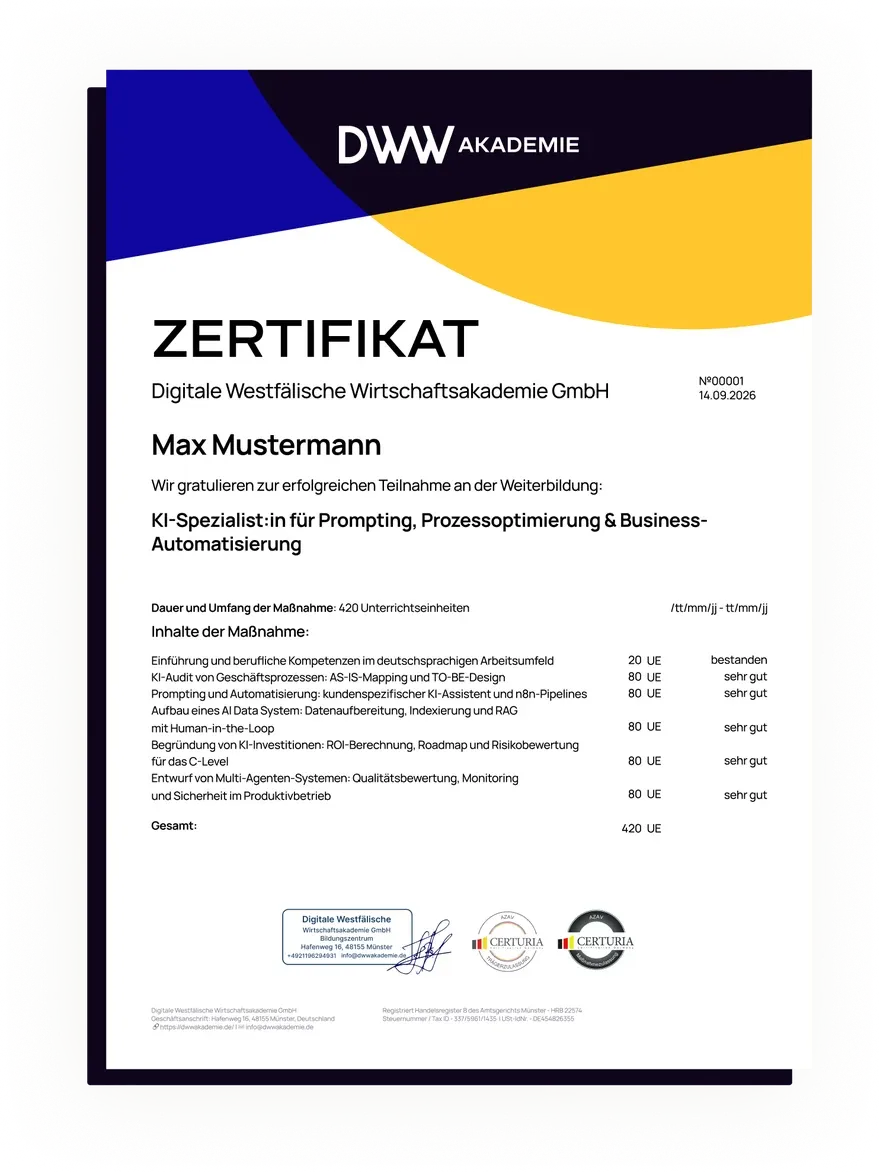
DWW Akademie certificate

After completing the course, you’ll receive a certificate from Digitale Westfälische Wirtschaftsakademie with a Certuria seal. It confirms that you completed 420 UE (teaching units).

Sample DWW Akademie certificate for the AI specialist course

Any questions?

Ask your education adviser or contact our support team. We’ll be happy to answer your questions.

Address

Hafenweg 16, 48155 Münster, Germany

Vintage telephone with yellow and blue shapes